Inspiring children in sport
Safeguarding Chid Protection
Safeguarding Policy for Sports Coaching Specialists (SCS) Ltd
|
Designated Safeguarding Lead (DSL): |
Angelo Harrop |
|
Deputy Designated Safeguarding Lead (DDSL): |
Kay Harrop |
|
Date of Policy: |
2nd January 2025 |
|
Approved by: |
Angelo Harrop – Managing Director Kay Harrop – Consultant Safeguarding Practitioner |
|
Date of Approval: |
2nd January 2025 |
|
Date of Review: |
2nd January 2026 |
This below statement should be read in conjunction with the Southend Essex and Thurrock (S.E.T) Child Protection Policies and Procedures.
The purpose of this policy statement is:
- To provide staff and volunteers, as well as children and young people and their families, with the overarching principles that guide our approach to safeguarding.
- This policy applies to anyone working on behalf of Sports Coaching Specialists Ltd (SCS) including managers, and any paid coaching staff, volunteers, sessional workers, agency staff and or students.
We at SCS believe that:
- Children and young people should never experience abuse of any kind.
- We at SCS have a responsibility to promote the welfare of all children and young people, to keep them safe and to practice in a way that protects them from harm.
We at SCS recognise that:
- The welfare of children is paramount in all the work we do and in all the decisions we take all children, regardless of age, disability, gender, race, religion or belief, or sexual orientation have an equal right to protection from all types of harm or abuse.
- Some children are additionally vulnerable because of the impact of previous experiences, their level of dependency, communication needs or other issues.
- Working in partnership with children, young people, their parents, carers, and other agencies is essential in promoting children and young people’s welfare.
We at SCS will seek to keep children and young people safe by:
- Valuing, listening to and respecting them.
- Ensuring there is a Designated Safeguarding Lead and Deputy Designated Safeguarding Lead for children and young people.
- Adopting safeguarding best practice through our policies, procedures, and code of conduct for staff and volunteers.
- On-going learning and development around online safety procedures for staff and volunteers.
- SCS Management will ensure all staff and volunteers are made aware of their individual and collective responsibility to follow SCS policies, procedures and behaviour codes confidently and competently – this will be undertaken via training, regular supervision and support.
- Safer Recruitment of staff and volunteers – ensuring each individual has an Enhanced DBS clearance in place prior to commencing employment or placement.
- Recording, storing and using information professionally and securely, in line with data protection legislation and guidance.
- Ensuring that we provide a safe physical environment for our children, young people, staff and volunteers, by applying health and safety measures in accordance with the law and regulatory guidance.
- Building a safeguarding culture where staff and volunteers, children, young people and their families, treat each other with respect
- Any concerns raised by individuals (staff/volunteers/children/young people/families/carers) are acted upon in the appropriate manner and safeguarding procedures are followed.
Designated Safeguarding Lead
Name: Angelo Harrop
Role: Company Director SCS
Email: scssportsteam@gmail.com
Phone: 07989 173744
Deputy Designated Safeguarding Lead
Name: Kay Harrop
Role: Consultant Safeguarding Practitioner
Phone: 07775 922452
Contents
|
1 |
Introduction |
|
2 |
Statutory Framework |
|
3 |
Roles and Responsibilities |
|
4 |
Types of Abuse / Specific Safeguarding Issues |
|
5 |
Children/young people potentially at risk of greater harm |
|
6 |
Procedures |
|
7 |
Training |
|
8 |
Professional Confidentiality |
|
9 |
Records and Information Sharing |
|
10 |
Allegations about members of the workforce |
|
11 |
Use of Reasonable Force |
|
12 |
Whistleblowing |
|
Appendix A |
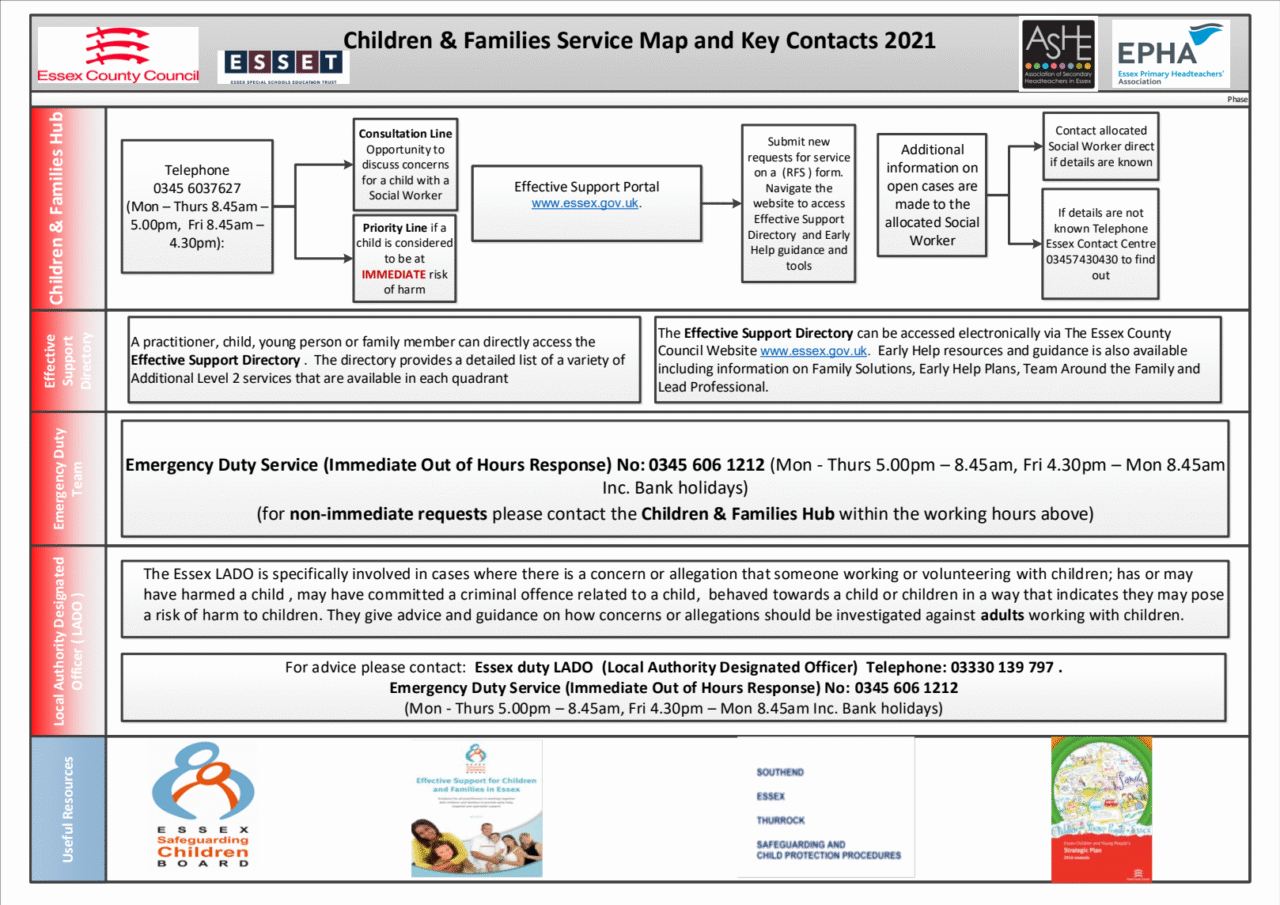
Children and Families Service Map and Key Contacts |
- Introduction
“Schools and their staff form part of the wider safeguarding system for children. Everyone who comes into contact with children and their families and carers has a role to play in safeguarding children. In order to fulfil this responsibility effectively, all professionals should make sure their approach is child-centred. This means that they should consider, at all times, what is in the best interests of the child”
(Keeping Children Safe in Education – DfE, 2021)
This policy is for all SCS staff, volunteers, and apprentices. It forms part of the safeguarding arrangements for SCS and should be read in conjunction with the list of relevant legislation, policies and procedures listed in part 2 (below).
SCS has a whole-company approach to safeguarding, which ensures that keeping children and young people safe is at the heart of everything we do and underpins our practice, processes and policies.
It is important that our values are understood and shared by all SCS staff, parents/carers and the organisations we work with. Only by working in partnership, can we truly keep children and young people safe.
- Statutory Framework
There is government guidance set out in Working Together (DfE, 2018) on how agencies must work in partnership to keep children safe. This guidance places a shared and equal duty on three Safeguarding Partners (the Local Authority, Police and Health) to work together to safeguard and promote the welfare of all children in their area under multi-agency safeguarding arrangements. These arrangements sit under the Essex Safeguarding Children Board (ESCB). In Essex, the statutory partners are Essex County Council, Essex Police and five of the seven Clinical Commissioning Groups covering the county.
Section 175 of the Education Act 2002 (Section 157 for Independent schools) places a statutory responsibility on the governing body to have policies and procedures in place that safeguard and promote the welfare of children who are pupils of the school.
In Essex, all professionals must work in accordance with the SET Procedures . SCS also works in accordance with the following legislation and guidance (this is not an exhaustive list):
Keeping Children Safe in Education (DfE, 2021)
Counter-Terrorism and Security Act (HMG, 2015)
Serious Crime Act 2015 (Home Office, 2015)
Children and Social Work Act (2017)
Children Missing Education – statutory guidance for local authorities (DfE, 2016)
Sexual Offences Act (2003)
Information sharing advice for safeguarding practitioners (HMG, 2018)
What to do if you’re worried a child is being abused (HMG, 2015)
Children Act (1989) & (2004)
Preventing and Tackling Bullying (DfE, 2017)
Female Genital Mutilation Act 2003 (S. 74 – Serious Crime Act 2015)
Sexual violence and sexual harassment between children in schools and colleges (DfE, 2021)
Promoting positive emotional well-being and reducing the risk of suicide (ESCB, 2018)
Preventing youth violence and gang involvement (Home Office, 2015)
Criminal Exploitation of children and vulnerable adult – county lines guidance (Home Office, 2018)
Teaching on-line safety in schools (DfE, 2019)
- Roles and Responsibilities
All adults working with or on behalf of children and young people have a responsibility to protect them and to provide a safe environment in which they can learn and achieve their full potential. However, there are identified key people within SCS who have specific responsibilities under Safeguarding procedures. The names of those in SCS with these specific responsibilities (the designated safeguarding lead and deputy designated safeguarding lead) are shown on the cover sheet of this document. However, we are clear that safeguarding is everyone’s responsibility and that everyone who comes into contact with children and young people has a role to play.
SCS Ltd ensures that the policies, procedures and training in our company are effective and comply with the law at all times. It ensures that all required policies relating to safeguarding are in place, that the safeguarding policy reflects statutory and local guidance and is reviewed at least annually.
The Designated Safeguarding Leads (DSLs) for safeguarding arrangements are named on the front cover of this document. These individuals take strategic responsibility at Director level for safeguarding arrangements in our company.
SCS ensures that it contributes to inter-agency working, in line with statutory and local guidance. It ensures that information is shared and stored appropriately and in accordance with statutory requirements.
SCS ensures that all adults in our company who work with children and young people undergo safeguarding training at induction as appropriate and that it is regularly updated. All staff members receive regular safeguarding updates, at least annually, to provide them with the relevant skills and knowledge to keep the children and young people safe that we work with.
Company Director
The Company Director role in SCS should safeguard children and young people’s wellbeing and maintain public trust in the coaching profession as part of their professional duties. The Company Director works in accordance with all statutory requirements for safeguarding and is responsible for ensuring that safeguarding policies and procedures adopted by the company are followed by all staff.
The Designated Safeguarding Leads (DSLs)
The DSLs in SCS have ultimate lead responsibility for safeguarding. Their role includes working with other agencies, ensuring all staff are appropriately trained and raising awareness of all safeguarding policies and procedures.
They ensure that everyone who is employed by SCS (including temporary staff and volunteers) are aware of these procedures and that they are followed at all times.
They act as a source of advice and support for all staff (on safeguarding matters) and ensure that they follow current SET procedures when safeguarding matters arise.
They work with the local authority and the ESCB as required and ensure that information is shared appropriately.
The Deputy DSL is trained to the same standard as the DSL. If, for any reason, the DSL is unavailable, the Deputy DSL will act in their absence.
All SCS Staff
Everyone in our company has a responsibility to provide a safe environment in which our children and young people can participate.
They are aware of signs of abuse and neglect so they are able to identify children and young people who may be in need of help or protection.
All staff members are aware of and follow company processes (as set out in this Safeguarding Policy) and are aware of how to make a referral to Social Care if there is a need to do so.
If staff have any concerns about a child or young person’s welfare, they must act on them immediately and speak with the DSL (or deputy) – they do not assume that others have taken action.
- Types of Abuse / Specific Safeguarding Issues
Keeping Children Safe in Education (DfE, 2021) describes abuse in the following way:
“Somebody may abuse or neglect a child by inflicting harm or by failing to act to prevent harm. Children may be abused in a family or in an institutional or community setting by those known to them or, more rarely, by others. Abuse can take place wholly online, or technology may be used to facilitate offline abuse. Children may be abused by an adult or adults or another child or children”
Keeping Children Safe in Education refers to four categories of abuse:
- Physical
- Emotional
- Sexual
- Neglect
Our staff will always reassure children and young people who report abuse / victims of abuse that they are taken seriously and that they will be supported and kept safe. We will never make a child or young person feel ashamed for reporting abuse, nor make them feel they are causing a problem.
All staff in our company are able to identify possible signs of abuse/neglect and confidently respond in an appropriate and proportionate way.
All staff are aware of environmental factors which may impact on a child/young person’s welfare and safety and understand safeguarding in the wider context (contextual safeguarding).
In addition, staff are aware of other types of abuse and safeguarding issues that can put children/young people at risk of harm. We understand that behaviours linked to issues such as drug taking and / or alcohol misuse, deliberately missing education and consensual / non-consensual sharing of nudes and semi-nudes images can be signs that children are at risk.
Child Criminal Exploitation (CCE) and Child Sexual Exploitation (CSE)
Both CCE and CSE are forms of abuse that occur where an individual or group takes advantage of an imbalance in power to coerce, manipulate or deceive a child into taking part in sexual or criminal activity, in exchange for something the victim needs or wants, and/or for the financial advantage or increased status of the perpetrator or facilitator and/or through violence or the threat of violence. CSE and CCE can affect children, both male and female and can include children who have been moved (commonly referred to as trafficking) for the purpose of exploitation.
Some specific forms of CCE can include children being forced or manipulated into transporting drugs or money through county lines, working in cannabis factories, shoplifting or pickpocketing. They can also be forced or manipulated into committing vehicle crime or threatening/committing serious violence to others.
Child Sexual Exploitation (CSE) is a form of child abuse, which can happen to any child/young person from any background or community. It may occur over time, or be a one-off occurrence. The definition of Child Sexual Exploitation (CSE) from the Department of Education (DfE, 2017) is:
“Child Sexual Exploitation is a form of child sexual abuse. It occurs when an individual or group takes advantage of an imbalance of power to coerce, manipulate or deceive a child or young person under the age of 18 into sexual activity (a) in exchange for something the victim needs or wants, and/or (b) for the financial advantage or increased status of the perpetrator or facilitator. The victim may have been sexually exploited even if the sexual activity appears consensual. Child sexual exploitation does not always involve physical contact; it can also occur through the use of technology”.
It is understood that a significant number of children/young people who are victims of CSE go missing from home, care and education at some point. Our company is alert to the signs and indicators of a child becoming at risk of, or subject to, CSE and will take appropriate action to respond to any concerns. The DSL will lead on these issues and work with other agencies as appropriate.
Contextual Safeguarding
Safeguarding incidents and behaviours can be associated with factors outside our company. All staff are aware of contextual safeguarding and the fact they should consider whether wider environmental factors present in a child/young person’s life are a threat to their safety and / or welfare. To this end, we will consider relevant information when assessing any risk to a child/young person and share it with other agencies to support better understanding of a child/young person and their family.
Domestic Abuse
Domestic abuse can encompass a wide range of behaviours and may be a single incident or a pattern of incidents. Domestic abuse is not limited to physical acts of violence or threatening behaviour, and can include emotional, psychological, controlling or coercive behaviour, sexual and/or economic abuse. Our company recognises that exposure to domestic abuse can have a serious, long-term emotional and psychological impact on children. We work with other key partners and will share relevant information where there are concerns that domestic abuse may be an issue for a child/young person or family or be placing a child/young person at risk of harm.
So-called ‘honour-based violence’ (including Female Genital Mutilation and forced marriage)
Female Genital Mutilation (FGM) comprises all procedures involving partial or total removal of the external female genitalia or other injury to female genital organs. It is illegal in the UK and a form of child abuse.
As of October 2015, the Serious Crime Act 2015 (Home Office, 2015) introduced a duty on professionals to notify the Police of known cases of female genital mutilation where it appears to have been carried out on a girl under the age of 18. Our school will operate in accordance with the statutory requirements relating to this issue, and in line with local safeguarding procedures.
A forced marriage is one entered into without the full consent of one or both parties. It is where violence, threats or other forms of coercion is used and is a crime. Our staff understand how to report concerns where this may be an issue.
Mental Health
Our staff are aware that mental health problems can, in some cases, be an indicator that a child/young person has suffered or is at risk of suffering abuse, neglect or exploitation. We understand that, where children have suffered abuse or other potentially traumatic adverse childhood experiences, this can have a lasting impact throughout childhood, adolescence and into adulthood. Where we have concerns that this may impact on mental health, we will seek advice and work with other agencies as appropriate to support a child/young person and ensure they receive the help they need.
Positive mental health is the concern of the whole community and we recognise that our company can play a key part in this. SCS aims to develop the emotional wellbeing and resilience of all attendees at their sessions, as well as provide specific support for those with additional needs.
We understand that there are risk factors which increase someone’s vulnerability and protective factors that can promote or strengthen resiliency. The more risk factors present in an individual’s life, the more protective factors or supportive interventions are required to counter-balance and promote further growth of resilience.
It is vital that we work in partnership with parents/carers to support the well-being of our attendees. Parents/carers should share any concerns about the well-being of their child/young person with SCS’ DSLs.
Online Safety
We recognise that our children are growing up in an increasingly complex world, living their lives on and offline. This presents many positive and exciting opportunities, but we recognise it also presents challenges and risks. Any child/young person can be vulnerable online, and their vulnerability can fluctuate depending on their age, developmental stage and personal circumstance.
All staff in SCS are aware of the risks to children online and we seek to help children keep themselves safe online in a range of ways.
Peer on Peer Abuse
Our service may be the only stable, secure and safe element in the lives of children/young people at risk of, or who have suffered harm. Nevertheless, whilst at SCS sessions, their behaviour may be challenging and defiant, or they may instead be withdrawn, or display abusive behaviours towards other children. Our company recognises that some children/young people may abuse their peers and that this may happen during their sessions with us, or outside of it. Any incidents of peer on peer abuse will be managed in the same way as any other safeguarding concern and will follow the same procedures. We will seek advice and support from other agencies as appropriate.
Our company recognises that, even though peer on peer abuse / harmful sexual abuse may not be reported, it is likely that it is occurring and we are clear there is a zero tolerance to inappropriate or abusive behaviour.
Peer on peer abuse can manifest itself in many ways. We do not tolerate any harmful behaviour in during our sessions and will take swift action to intervene where this occurs, challenging any inappropriate behaviours – we do not normalise abuse, or allow a culture where it is tolerated.
We will never make a child feel ashamed for reporting abuse, nor that they are creating a problem by doing so.
Serious Violent Crime
All staff are aware of the risk factors and indicators which may signal that children/young people are at risk from or involved with serious violent crime this includes Child Exploitation.
- Children potentially at risk of greater harm
We recognise that some children may potentially be at risk of greater harm and require additional help and support. These may be children with a Child in Need or Child Protection Plan, those in Care or previously in Care or those requiring mental health support.
Our company understands that children with Special Educational Needs (SEN) and / or Disabilities can face additional safeguarding challenges. Barriers can exist when recognising abuse and neglect in this group of children. These can include:
- Assumptions that indicators of possible abuse such as behaviour, mood and injury relate to the child’s disability, without further exploration
- That they may be more prone to peer group isolation than others
- The potential to be disproportionally impacted by things like bullying, without outwardly showing signs
- Communication difficulties in overcoming these barriers
6. Procedures
SCS works with key local partners to promote the welfare of children/young people.
All staff members have a duty to identify and respond to suspected / actual abuse or disclosures of abuse. Any member of staff or volunteer who receives a disclosure or allegation of abuse from a child/young person, or suspects that abuse may have occurred, must report it immediately to the DSL (or, in their absence, the Deputy DSL).
All action is taken in accordance with the following guidance:
- Essex Safeguarding Children Board guidelines – the SET (Southend, Essex and Thurrock) Child Protection Procedures (ESCB, 2019)
- Essex Effective Support
- Keeping Children Safe in Education (DfE, 2021)
- Working Together to Safeguard Children (DfE, 2018)
- ‘Effective Support for Children and Families in Essex’ (ESCB)
Where there is risk of immediate harm, concerns will be referred by telephone to the Children and Families Hub (Children’s Social Care) and/or the Police.
When SCS are delivering sessions for an education/other setting any safeguarding concerns will be discussed with the setting’s DSL by SCS’ DSLs.
When SCS are delivering sessions within their own grounds, any potential concerns around children/young people will be discussed with the parent/carer in the first instance, and consent will sought for SCS DSL to contact the Essex Children and Families Hub for further consideration to support the family.
SCS may also seek advice from Children’s Social Care or another appropriate agency about a concern, if they are unsure how to respond to it.
Wherever possible, we will share any safeguarding concerns, or an intention to refer a child/young person to Children’s Social Care, with parents or carers. However, we will not do so where it is felt that to do so could place a child/young person at greater risk of harm or impede a criminal investigation.
On occasions, it may be necessary to consult with the Children and Families Hub and/or the Police for advice on when to share information with parents/carers.
If, for any reason, the SCS DSLs are not available, this will not delay appropriate action being taken. Safeguarding contact details are displayed within SCS company documents to ensure that all staff members have access to safeguarding procedures, should it be required. Any individual may refer to Children’s Social Care where there is suspected or actual risk of harm to a child.
When new staff or volunteers join our company they are informed of the safeguarding arrangements in place, the name of the DSLs and how to share concerns with them.
- Training
In line with statutory requirements, the DSLs undertake Level 3 Child Protection training at least every two years.
All staff members receive appropriate safeguarding training which is regularly updated and in line with advice from the Essex Safeguarding Children Board (ESCB) and Grass Roots National Football Coaching. In addition, all staff members and other adults working with children/young people in our company receive safeguarding updates as required, but at least annually, to provide them with relevant skills and knowledge to safeguard children/young people effectively. Records of any safeguarding training undertaken are kept for all staff and volunteers.
SCS ensures that the DSLs also undertakes training in inter-agency working and other matters as appropriate.
- Professional Confidentiality
Confidentiality is an issue which needs to be discussed and fully understood by all those working with children/young people, particularly in the context of safeguarding. A member of staff must never guarantee confidentiality to anyone about a safeguarding concern (including parents / carers or children/young people) or promise to keep a secret. In accordance with statutory requirements, where there is a safeguarding concern, this must be reported to the DSL and may require further referral to and subsequent investigation by appropriate authorities.
Information on individual safeguarding matters may be shared by the DSLs with other relevant staff members. This will be on a ‘need to know’ basis only and where it is in the child/young person’s best interests to do so.
- Records and Information Sharing
Well-kept records are essential to good safeguarding practice. SCS is clear about the need to record any concern held about a child/young person attending our sessions and when these records should be shared with other agencies.
Where there are concerns about the safety of a child/young person, the sharing of information in a timely and effective manner between organisations can reduce the risk of harm. Whilst the Data Protection Act 2018 places duties on organisations and individuals to process personal information fairly and lawfully, it is not a barrier to sharing information where the failure to do so would result in a child or vulnerable adult being placed at risk of harm. Similarly, human rights concerns, such as respecting the right to a private and family life would not prevent sharing information where there are real safeguarding concerns. Fears about sharing information cannot be allowed to stand in the way of the need to safeguard and promote the welfare of children/young people at risk of abuse or neglect.
10. Allegations about members of the workforce
All staff members are made aware of the boundaries of appropriate behaviour and conduct. These matters form part of staff induction and are outlined in the SCS Staff Code of Conduct. SCS works in accordance with statutory guidance and the SET procedures (ESCB, 2019) in respect of allegations against an adult working with children/young people (in a paid or voluntary capacity).
SCS has processes in place for reporting any concerns about a member of staff (or any adult working with children). Any concerns about the conduct of a member of staff must be referred to the Company Director and DSL, as they have responsibility for managing employment issues.
Where the concern involves the Company Director, it should be reported to the Managing Director who will remain impartial to any investigation.
The SET procedures (ESCB, 2019) require that, where an allegation against a member of staff is received, the Company Director and DSL must inform the Local Authority Designated Officer (LADO) in the Children’s Workforce Allegations Management Team on 03330 139 797 within one working day. However, wherever possible, contact with the LADO will be made immediately as they will then advise on how to proceed and whether the matter requires Police involvement. This will include advice on speaking to children/young people, parents/carers and the HR contact for SCS. SCS does not carry out any investigation before speaking to the LADO.
Staffing matters are confidential and SCS operates within a statutory framework around Data Protection.
12. Use of Reasonable Force
The term ‘reasonable force’ covers a broad range of actions used by staff that involve a degree of physical contact to control or restrain children. There are circumstances when it is appropriate for staff to use reasonable force to safeguard children and young people, such as guiding a child/young person to safety or breaking up a fight. ‘Reasonable’ means using no more force than is needed. SCS works in accordance with statutory and local guidance on the use of reasonable force (see section 2) and recognises that where intervention is required, it should always be considered in a safeguarding context.
- Whistleblowing
All members of SCS staff should be able to raise concerns about poor or unsafe practice and feel confident any concern will be taken seriously by SCS senior management. For any member of staff who feels unable to raise concerns internally, or where they feel their concerns have not been addressed, they may contact the NSPCC whistleblowing helpline on: 0800 028 0285 (line is available from 8:00 AM to 8:00 PM, Monday to Friday) or by email at: help@nspcc.org.uk.
Parents/carers or others in the wider community with concerns can contact the NSPCC general helpline on: 0808 800 5000 (24 hour helpline) or email: help@nspcc.org.uk.
Appendix A: Children and Families Service Map and Key Contacts